


What more reinforcing propaganda is there than to give a political swan song before death?
For you are bound to tell your truth, whatever truth that may be.
We believe this in our country, too. We believe in deathbed confessions, suicide notes, and dying declarations. The truth is, we can lie at death and know it. We can lie at death and think we are telling the truth.
Then there is the time of learning fundamentals--the foundations of truth. If you don't watch the first one, watch this one, where an imitation Mickey Mouse has an appalling job and probably does it quite well.
Palestinian Watch is an "Israeli research institute that studies Palestinian society from a broad range of perspectives by monitoring and analyzing the Palestinian Authority through its media and schoolbooks. PMW�s major focus is on the messages that the Palestinian leaders, from the Palestinian Authority, Fatah and Hamas, send to the population through the broad range of institutions and infrastructures they control."
According to Wikipedia, the organization seeks to let the European Union know what its foreign aid and business investment in Palestinian media is bringing forth. However, their offices are in Israel and they have a Director in North America, not the European Union--at least, not at the Web site I visited. What I am saying is that there is more than one competing indoctrination embedded in this post. The first is the videos. The second is the editing I have done, and that Palestinian Watch has done.
Nothing is straightforward in the Near East--or perhaps anywhere. No one is perhaps blameless, or free from prejudice there as well as anywhere else. However, these videos are quite a shock.
I originally went looking for indoctrination videos and pictures--I keep trying to understand the limits of my own values, and (less personally) also how groups perpetuate themselves. The way I examined my first set of values was to go to school--and get perhaps a competing indoctrination, and then try to work with the contradictions to decide for myself. According to these videos, there is not a lot of competition here--only 1 Big 1 indoctrination.
--Wikipedia on Hamas
--Wikipedia on Fatah
--Wikipedia on Revisionist Zionism
I'm looking for some great thoughts here. If you have some, I'd love to see them in the comments.
|
|||||
|---|---|---|---|---|---|
|
Showing posts with label int'l relations. Show all posts
Showing posts with label int'l relations. Show all posts
Tuesday, January 25, 2011

Monday, August 2, 2010
World Economists: Paul Collier
Paul Collier is a Professor of Economics at Oxford University. He has written a prize-winning book on foreign aid, world poverty, and local wars in places such as Somalia and the Sudan. The book is called The Bottom Billion and you can probably buy it anywhere. Another book, the Plundered Planet, talks about how environmental concerns affect the poor--both hurting them and taking away assistance for their economic plight. He is an even-handed man.
Professor Colllier is not an actor. He sounds like a teacher. And he is so worth listening to, if not for international relations, for poverty reduction here in the United States. "An alliance of compassion and enlightened self-interest." He talks about the Marshall Plan.
Before you make up your mind, two minutes in, that this is some liberal do-gooder, he has no patience for the language of grievance, or for the political discourse of victimology as related to civil war and warlords. He is brilliant and until recently has worked in relative obscurity, attracting neither celebrities nor panic-mongers. It is well worth considering his arguments.
In the post above, I looked at Mr. Collier's work in regard to civil conflict. This represents some of his more recent thinking, based upon his earlier research. Mr. Collier thinks for himself. It is well worth a listen.

Professor Colllier is not an actor. He sounds like a teacher. And he is so worth listening to, if not for international relations, for poverty reduction here in the United States. "An alliance of compassion and enlightened self-interest." He talks about the Marshall Plan.
Before you make up your mind, two minutes in, that this is some liberal do-gooder, he has no patience for the language of grievance, or for the political discourse of victimology as related to civil war and warlords. He is brilliant and until recently has worked in relative obscurity, attracting neither celebrities nor panic-mongers. It is well worth considering his arguments.
In the post above, I looked at Mr. Collier's work in regard to civil conflict. This represents some of his more recent thinking, based upon his earlier research. Mr. Collier thinks for himself. It is well worth a listen.
Books by Paul Collier
The Bottom Billion. Available.
The Bottom Billion. Available.
The Plundered Planet. Available.
Wednesday, July 14, 2010
A British View of American Slavery, 1838-1839
Like Fanny Trollope, Fanny Kemble was of British birth, a visitor to the United States. Both came from the middle class. I suspect Mrs. Trollope's status may have been higher than Ms. Kemble's, but that Ms. Kemble's reach in British society may have been a little greater, owing to her cosmopolitan profession. Both of them received good schooling, and were well-inculcated with British abolitionist sentiments.
Frances Ann Kemble Butler
 Fanny Kemble was from the famous acting family in London, operators of the Drury Lane and Covent Garden Theatres. The famous Sarah Siddons was her aunt. Fanny was a good actress gaining good reviews, but owing to the steadily decreasing fortunes of the family, she was a bit sick of the whole business. Her family sold their theatres, which were failing, and Fanny came with some of her family to work in New York and other major American cities.
She fell in love with Pierce Butler of Philadelphia, who represented himself as a man of genteel means. They married in 1834; in 1835 Fanny learned that the Butler money came from a plantation operating on the Georgia Sea Islands. Raised with abolitionist sentiments, she suddenly found she was the beneficiary of slave labor. She then determined that she would go to the plantation, but the family vetoed this. Eventually the trustee to Pierce Butler's estate died, and the estate manager quit. Pierce Butler and his brother had to take charge, starting in 1838.
Her diary for the years 1838-1839 is full of conflict between the regard she had for her husband and her moral compass, her sentiments toward him and her observations of the cruelties of plantation life. To add to this dilemma, she and Butler had children by then. Fanny stuck it out, hoping she could get her husband to change his relationship to the slaves, even perhaps moving the plantation and granting manumission to them.

In 1840, she consolidated the diary for publication. That year, Pierce Butler, Fanny, and the children sailed to England to visit his father. By 1843 they were separated; by 1849, divorced. Custody of the children went to Mr. Butler. His plantation was sold for debts in 1859. In the meantime, Fanny had returned to the stage.
The diary was not published until 1862, and in England first. The decision to publish at last came at a time when British sentiment was veering toward the Confederacy. Its publication was a sensation, and many, on both sides of the conflict, believe this journal helped turn the tide of public opinion in Great Britain against the South. It was published there in 1863, and in New York some months later.
The following entry is a domestic argument about a flogging of a slave. Pretty much I just opened the book, and there it was. She calls her husband "Mr." in the diary.
--
February, 1839
Slavery as described here was a system that, it seemed, forced everyone into a regulated system and limited the lives of all involved. In Trollope's account, slavery seems like a reckless, disordered, and ill-thought-out system. It may be that both are true simultaneously. It may be that differences in their placement (mistress v. observer) privileges different views. Both record slavery's dehumanizing and limiting world view for all concerned.
Diplomacy Influenced by Public Opinion
I have included these accounts to show how close it was, in diplomatic terms, that Britain might have come to disrupting Lincoln's blockade of the South. For any nation to acknowledge the Confederate States of America would have been disastrous to the Union cause: and no nation more so than Great Britain, with the best Navy, at that time, on the planet.
These accounts also explain Lincoln's aversion to the institution of slavery, which he saw on his wife's family's plantation and had already philosophically opposed.
It also helps describe another worldwide market--the market for ideas--that spans borders. It is a part of our globalization today. It is also a part of the globalization of the United States, and the forces at work, in the pre-Civil War and Civil War period. And just as this affects outcomes today, it affected outcomes then, too.
Reference:
Frances Ann Kemble, Journal of a Residence on a Georgian Plantation in 1838-1839. Edited, with an introduction by John A. Scott. The University of Georgia Press. (pp. 159-160). I am not sure it is still in print, but it is probably available through used book exchanges on the Internet. UPDATE: It IS available from the University of Georgia Press!
photos: Friends of the Blue Hills dot org and Georgia Pioneers dot com.
Frances Ann Kemble Butler

She fell in love with Pierce Butler of Philadelphia, who represented himself as a man of genteel means. They married in 1834; in 1835 Fanny learned that the Butler money came from a plantation operating on the Georgia Sea Islands. Raised with abolitionist sentiments, she suddenly found she was the beneficiary of slave labor. She then determined that she would go to the plantation, but the family vetoed this. Eventually the trustee to Pierce Butler's estate died, and the estate manager quit. Pierce Butler and his brother had to take charge, starting in 1838.
Her diary for the years 1838-1839 is full of conflict between the regard she had for her husband and her moral compass, her sentiments toward him and her observations of the cruelties of plantation life. To add to this dilemma, she and Butler had children by then. Fanny stuck it out, hoping she could get her husband to change his relationship to the slaves, even perhaps moving the plantation and granting manumission to them.

The Butler Plantation.
In 1840, she consolidated the diary for publication. That year, Pierce Butler, Fanny, and the children sailed to England to visit his father. By 1843 they were separated; by 1849, divorced. Custody of the children went to Mr. Butler. His plantation was sold for debts in 1859. In the meantime, Fanny had returned to the stage.
The diary was not published until 1862, and in England first. The decision to publish at last came at a time when British sentiment was veering toward the Confederacy. Its publication was a sensation, and many, on both sides of the conflict, believe this journal helped turn the tide of public opinion in Great Britain against the South. It was published there in 1863, and in New York some months later.
The following entry is a domestic argument about a flogging of a slave. Pretty much I just opened the book, and there it was. She calls her husband "Mr." in the diary.
--
February, 1839
On my return from the river [outfitting the infirmaries for the slaves around the islands, actually-ATH] I had a long and painful conversation with Mr. [Butler] upon the subject of the flogging which had been inflicted on the wretched Teresa. These discussions are terrible; they throw me into perfect agonies of distress for the slaves, whose position is utterly hopeless; for myself, whose intervention on their behalf sometimes seems to me worse than useless; for Mr., whose share in this horrible system fills me by turns with indignation and pity. . . . how should he wish to help it? and, of course, he does not; and I am in despair that he does not: et voila, it is a happy and hopeful plight for us both. He maintained that there had been neither hardship nor injustice in the case of Teresa's flogging; and that, moreover, she had not been flogged at all for complaining to me, but simply because her alloted task was not done at the appointed time. Of course this was the result of her having come to appeal to me instead of going to her labor; and as she knew perfectly well, the penalty she was incurring, he maintained that there was neither hardship nor injustice in the case; the whole thing was a regularly established law, with which all the slaves were perfectly well acquainted; and this case was no exception whatever. The circumstance of my being on the island could not, of course, be allowed to overthrow the whole system of discipline established to secure the labor and obedience of the slaves; and if they chose to try experiments as to that fact, they and I must take the consequences. At the end of the day, the driver of the gang to which Teresa belongs reported her work not done, and Mr. O ordered him to give her the usual number of stripes, which order the driver of course obeyed, whithout knowing how Teresa had employed her time instead of hoeing. Mr. Mr. O knew well enough, for the wretched woman told me that she had herself told him she should appeal to me about her weakness, and suffering, and inability to do the work exacted from her.
( . . . .)
. . . to Mr. Butler's assertion of the justice of poor Teresa's punishment, I retorted the manifest injustice of unpaid and enforced labor; the brutal inhumanity of allowing a man to strip and lash a woman, the mother of ten children to exact from her, toil, which was to maintain in luxury two idle young men, the owners of the plantation. I said I thought female labor of the sort exacted from these slaves, and corporal chastisement such as they endure, must be abhorrent to any manly or humane man. Mr. said he thought it was disagreeable, and left me to my reflections with that concession.You can see that this marriage was not going to make it, even in an age where divorce was hard to obtain. Furthermore, it's very possible that Fanny's presence on the plantation made things mostly worse for those she tried to aid. As soon as any slave was observed entreating her, they may well have been singled out for extra duties or punishments.
Slavery as described here was a system that, it seemed, forced everyone into a regulated system and limited the lives of all involved. In Trollope's account, slavery seems like a reckless, disordered, and ill-thought-out system. It may be that both are true simultaneously. It may be that differences in their placement (mistress v. observer) privileges different views. Both record slavery's dehumanizing and limiting world view for all concerned.
Diplomacy Influenced by Public Opinion
I have included these accounts to show how close it was, in diplomatic terms, that Britain might have come to disrupting Lincoln's blockade of the South. For any nation to acknowledge the Confederate States of America would have been disastrous to the Union cause: and no nation more so than Great Britain, with the best Navy, at that time, on the planet.
These accounts also explain Lincoln's aversion to the institution of slavery, which he saw on his wife's family's plantation and had already philosophically opposed.
It also helps describe another worldwide market--the market for ideas--that spans borders. It is a part of our globalization today. It is also a part of the globalization of the United States, and the forces at work, in the pre-Civil War and Civil War period. And just as this affects outcomes today, it affected outcomes then, too.
Reference:
Frances Ann Kemble, Journal of a Residence on a Georgian Plantation in 1838-1839. Edited, with an introduction by John A. Scott. The University of Georgia Press. (pp. 159-160). I am not sure it is still in print, but it is probably available through used book exchanges on the Internet. UPDATE: It IS available from the University of Georgia Press!
photos: Friends of the Blue Hills dot org and Georgia Pioneers dot com.
Tuesday, July 13, 2010
A British View of American Slavery, 1832

The Utopian community went bust. Instead Mrs. Trollope traveled throughout the U.S. with her youngest children, starting small businesses, closing them down, and being received everywhere as a genteel visitor from England. Basically, she was in the 1827 version of the rubber-chicken circuit.
She repaid this hospitality by returning to England and describing us exactly as we appeared to her, in that particularly decided tone of writing that the English do so well. The only American of record who thought she was right was Mark Twain: in his opinion, she captured us dead on. I also have a high opinion of her; she seems to have made her way on two continents, starting businesses, making some money, failing and trying again. She is also very interesting to read on the American diet of the time, and the manners--such as the extreme segregation of the sexes--which she thought not conducive to good behavior or good conversation.
--
"I observed every where throughout the slave states that all articles which can be taken and consumed are constantly locked up, and in large families where the extent of the establishment multiplies the number of keys, these are deposited in a basket, and consigned to the care of a little negress, who is constantly seen following her mistress's steps with this basket on her arm . . . not only that the keys be on hand, but . . . should they be out of sight for one moment, that moment would infallibly be employed for purposes of plunder. It seemed to me . . . that the close personal attendance of these sable shadows, must be very annoying; but whenever I mentioned it, I was assured that no such feeling existed, and that use rendered them almost unconscious of their presence.
"I had, indeed, frequent opportunities of observing their habitual indifference to the presence of their slaves. They talk of them, of their condition, of their faculties, of their conduct, exactly as if they were incapable of hearing. I once saw a young lady, who, when seated at table between a male and a female, was induced by her modesty to intrude on the chair of her female neighbour to avoid the indelicacy of touching the elbow of a man. I once saw this very young lady lacing her stays with the most perfect composure before a negro footman. A Virginian gentleman told me that ever since he had married, he had been accustomed to have a negro girl sleep in the same chamber with himself and his wife. I asked for what purpose this nocturanl attendance was necessary? "Good heaven!" was the reply, "if I wanted a glass of water during the night, what would become of me?"I know, it almost sounds like the man was pulling her leg. I think it more likely the nocturnal attendant was there to get rid of the chamber pot. It would also be an interesting question of household security . . . to go to the kitchen for a glass of water . . . and so forth.
This book is one of the reasons that England believed the genteel South to be full of un-admirable people. Another such author who influenced England's stance in the Civil War was Fanny Kemble . . . stay tuned.
References:
Frances Trollope, Domestic Manners of the Americans, Penguin Books. Available.
Photo: Cincinnnati Library
Monday, July 12, 2010
Lincoln's Political Economy, part Three of Three
Last week, I wrote on Abraham Lincoln and the National Economy, part 1: income taxes, the national bank system, and the first U.S. savings bonds.
Shifts in International Trade During the Civil War

There are some other features of international trade, in regard to the "nations vs. markets", where Lincoln exercised "restraint-of-trade" actions. These are what some libertarians and other detractors find against him today.
The first is that Lincoln advocated a strong tariff regime, which was discussed in Lincoln and International Economy, Part 2. The second is that he used national clout and diplomacy to restrain trade for the South. The third is that by curtailing political freedom, in regard to the dis-United states of America, he infringed upon individual rights and individual commercial choices about how and where to conduct business.
Shifts in International Trade During the Civil War
I have already mentioned that Britain was incensed by the Morrill Tariff. Add to that a naval blockade by the Union against maritime trade with the South. Lincoln did not want international war at the same time as he had civil war. Therefore, diplomacy with Britain was key.
In a message to Congress (sweating in Special Session on July 4, 1861, during the stand-off at Fort Sumter), Lincoln noted that:
. . . this illegal organization, in the character of confederate States, was already invoking recognition, aid, and intervention from Foreign Powers.
Shelby Foote recounts how Jefferson Davis sent a delegation to both England and France, the Confederacy's best trading partners. He did not give his first nor his second delegation sufficient instructions or sufficient powers to cut deals on their own. Trying to get instruction from Davis via Atlantic ship messages, especially during blockade, limited their ability to see important people or revise their strategies.
As Great Britain was the primary world naval power, they were the best hope of the Confederacy to lift the Union blockade, so they went to London first.
But the South had two other major problems in their diplomacy: one, European mills had all the cotton they needed. They had been watching the U.S move toward conflict for a long time and had stockpiled supply. Second, Great Britain and France had already dealt with their own slavery question from the abolitionist point of view. By the time Manchester mills were hurting for supply, the shrugging 'neutrality' of British and French Foreign Offices had left the South with no political allies and no true diplomatic alliances. (I, pp. 135-137). And the laboring class in England did not approve of slavery, even when their factories were shutting down because of war-related shortages. (Letter, Lincoln to the Workingmen of Manchester, England, January 19, 1863).
Both Britain and France watched the war closely, waiting for an outcome and planning diplomatic measures as needed. By September of 1861, after the Battle of First Manassas, Britain was beginning to think they would have to recognize the CSA. They still wanted to wait and see. France, while more friendly to the Confederacy, had essentially the same attitude. (I, p. 666).
But the war dragged on, and so did blockade. The South's capacity to export continued to fall over time as labor went to war, or food became scarce. In the meantime, English and French manufacturers sought other world economies for cotton production: such as Egypt and India. Cotton was sold from Texas into Mexico, making its way to Europe. And a contraband trade in cotton with the Union began to occur, in exchange for currency and foodstuffs.
Lincoln's simple, consistent avowal that the Confederacy was an insurrection and not a state left other nations in diplomatic stalemate. Then Lincoln's active diplomacy was primarily a market-based diplomacy:
In the end, however, no European nation offered mediation nor extended recognition of the Confederacy. Among the reasons undermining active European intervention were several principal considerations. Economically, there were developments that shifted trade relations to emphasize the North's economic ties with Europe. To begin with, huge cotton exports in 1857-1860 had enabled English manufactures to stockpile inventories that carried them through much of the war. Additionally, new sources of cotton in Egypt and India replaced the southern supply after 1862. Furthermore, the Union became a major consumer of British iron, ships, armaments, and woolen uniforms and blankets, which absorbed the decline in the U.S. market for English cotton textiles. At the same time, crop failures in western Europe in 1861 and 1862 increased European dependence on American grain and flour, making King Corn as powerful as King Cotton.
The South financed its war on cotton futures on the foreign exchange at the same time it diminished its acreage for wartime needs (or had it destroyed during battles and occupation). They also added a (smaller) cotton tariff to finance the war. Eventually, according to Foote, they took over all legal cotton sales to Europe. Is that libertarian? No, it is desperate.
Lincoln financed his country on income tax, bond sales to U.S. citizens, and (less important, as it turned out) with tariffs.
Conclusion
Lincoln refused to consider individual liberty for businesses, states, and plantation owners that did not accord that same liberty to its workers, i.e. the slaves. There are examples of him just moving past the "popular sovereignty" campaigners to expose their fatal weakness. "Popular sovereignty" always masked a heinous lack of freedom for the slaves in the United States. Libertarian arguments founded on popular sovereignty, such as the freedom to run your plantation any darn way you choose, are just the same argument in a different century. Lincoln believed in the sanctity of labor, that it contributed to society, and as such, it must be paid labor.
Lincoln's speeches are peppered with references to agricultural and industrial tools, labor, and processes. He was a man with a wide acquaintance with the elements of industry. In his Lecture on Discoveries (February 11, 1859), he exults in trade diplomacy, where American railroad engineers go to Russia to consult. He praises the patent system as "adding the fuel of interest to the fire of genius, in the discovery and production of new and useful things."
In his First Inaugural Address (March 4, 1861), Lincoln said that secession would not solve the slavery dispute because of the proximity of borders:
In his First Inaugural Address (March 4, 1861), Lincoln said that secession would not solve the slavery dispute because of the proximity of borders:
. . . A husband and wife may be divorced, and go out of the presence, and beyond the reach of each other; but the different parts of our country cannot do this. . . Is it possible then to make that intercourse more advantageous, or more satisfactory, after separation than before? . . . Can aliens make treaties easier than friends can make laws? Can treaties be more faithfully enforced between aliens, than laws can among friends? Suppose you go to war, you cannot fight always, and when, after much loss on both sides, and no gain on either, you cease fighting; the identical old questions, as to terms of intercourse, are again upon you.We were perhaps past the notion of friendship at that point, but Lincoln's concerns about border security and continual conflict are valid. He also believed a nation together would have better efficiencies for trade in the long run. In his Annual Message to Congress (December 1, 1862), Lincoln began by talking about our nation's interior regions, and then expanded:
And yet this region has no sea-coast, touches no ocean anywhere. As part of one nation, its people now find, and may forever find, their way to Europe by New York, to South Americana and Africa by New Orleans, and to Asia by San Francisco. But separate our common country into two nations, as designed by the present rebellion, and every man of this great interior region is thereby cut off from some one or more of these outlets, not, perhaps, by a physical barrier, but by embarrassing and onerous trade regulations.
And this is true, wherever a dividing, or boundary line may be fixed. . . . These outlets, east, west, and south, are indispensable to the well-being of the people inhabiting, and to inhabit, this vast interior region.
By calling Lincoln in restraint of trade, his detractors ignore the restraint of trade involved in slavery. They posit that two national governments, with two different bureaucracies and extra borders, would have less trade restrictions, and less customs duties, less tariffs and less tax codes.
The truth is, the question of trade restraint needs most to be answered by the South. On the household level, they denied millions of slaves of the chance to participate in a free economy. On the desperation side, their government took over foreign commodity exchange in a way that the North never even contemplated (nor had to). Lincoln's tariff regime constituted no barrier to his trade diplomacy with Europe. And on the reduction of trade barriers question, which is what free markets is all about, the South erected a political border. This border would have changed the face of commerce and security on our Continent.
Most of all, Lincoln had heard the first generation of all of these arguments against him in his lifetime. He rejected and prevailed over them all.
The truth is, the question of trade restraint needs most to be answered by the South. On the household level, they denied millions of slaves of the chance to participate in a free economy. On the desperation side, their government took over foreign commodity exchange in a way that the North never even contemplated (nor had to). Lincoln's tariff regime constituted no barrier to his trade diplomacy with Europe. And on the reduction of trade barriers question, which is what free markets is all about, the South erected a political border. This border would have changed the face of commerce and security on our Continent.
Most of all, Lincoln had heard the first generation of all of these arguments against him in his lifetime. He rejected and prevailed over them all.
References:
Lincoln: Speeches and Writings, 1859-1865. Library of America. Available.
Civil War Home, using the Macmillan Information New Encyclopedia, linked above and here.
Shelby Foote, The Civil War: A Narrative, Volume I. Random House. Available.
The Miller Center, University of Virginia: Abraham Lincoln, part 5, linked above and here.
The Union Pacific Railroad, Lincoln and the Railroad, here. Is that restraint of trade?
William Wunder, The American System of National Republican and Whig Henry Clay, above and here.
Sunday, July 11, 2010
Lincoln's Political Economy, part Two of Three

Image via Wikipedia
Last week, I wrote on Abraham Lincoln and the National Economy, part 1: income taxes, the national bank system, and the first U.S. savings bonds. The national banks, along with the new national currency, gave the U.S. better control over their sovereign economy. It displaced the anarchy of individual bank currencies, state bank currencies, and other local arrangements. It also meant that our currency began to have an international value.
There's no question that this changed a feature of international banking--although, it did not necessarily make a huge stir until the 1890's.
There are some other features of international trade, in regard to the "nations vs. markets", where Lincoln exercised "restraint-of-trade" actions. These are what some libertarians and other detractors find against him today.
The first is that Lincoln advocated a strong tariff regime. The second is that he used national clout and diplomacy to restrain trade for the South. The third is that by curtailing political freedom, in regard to the dis-United States of America, he infringed upon individual rights and individual commercial choices about how and where to conduct business.
This post became so long, so I have divided it yet again. This one will be on tariffs. Tomorrow I will post on international trade patterns and the diplomacy that took place during the Civil War. It will also contain my conclusion.
Tariffs
There is at least one author, writing at a libertarian think tank, who calls Abraham Lincoln "The most ardent protectionist in American History." This author cites others of his frame of mind, who say that higher tariffs impelled Lincoln to invade the South. This opinion is hardly new. It was, in fact, the opinion of much of Great Britain, the significant trading partner of the South in cotton and other agricultural products, about the Morrill Tariff of 1861. (The Morrill Tariff was actually signed by Buchanan, but it was enforced and extended by Lincoln.)
Here is a quote from a magazine article in Great Britain (December 1861):
The conflict is between semi-independent communities [in which] every feeling and interest [in the South] calls for political partition, and every pocket interest [in the North] calls for union � So the case stands, and under all the passion of the parties and the cries of battle lie the two chief moving causes of the struggle. Union means so many millions a year lost to the South; secession means the loss of the same millions to the North. The love of money is the root of this, as of many other evils... [T]he quarrel between the North and South is, as it stands, solely a fiscal quarrel.Great Britain abolished slavery in 1833 within its borders, and previously, slave trade in its ships in 1807.
Lincoln was indeed for tariffs. In 1832, in a campaign briefly interrupted by the Black Hawk War, he made this speech, echoing the Whig platform of the time:
"Gentlemen and fellow citizens . . . I presume you all know who I am: I am humble Abraham Lincoln. I have been solicited by many friends to become a candidate for legislature. My politics are short and sweet, like the old woman's dance. I am in favor of a national bank. I am in favor of the internal-improvements system and a high protective tariff. These are my sentiments and political principles. If elected, I shall be thankful; if not, it will be all the same."He did not win that year, but in that district he came in first. And as we shall see, those beliefs stayed with him throughout the remainder of his life.
The difference in tariffs does cut along many of the same lines as the secession of states. There are some differences: the Northeast, with burgeoning industry, was definitely for high tariffs, but the Midwest was not universally for them. On the other side, Virginia was just beginning to industrialize, and wanted some protectionist measures in place for its beginning industry.
Vastly over-simplifying the tariff argument: "Buy & Sell American"
The South had a primarily agrarian economy that had reached economies of scale, (where large producers are able to avoid disproportionate costs--then add slavery as cheap labor to this). They were farming cash crops. The fabric mills to which they sold were predominantly in Great Britain. Therefore, they could do a steady trade back in manufactured goods. Their advantage was to have a low tariff regime for their imports, and avoid a high tariff disadvantage to exporting their cotton or other products. The Northeastern fabric mills wanted cotton exchange diverted to them. A tariff regime made it more likely that Northern states would gain advantages in trade, cutting Britain out. Then Southern states would exchange manufactured American goods for American agricultural products.
Either way, the South was headed for local trade deficits. Their prosperity under the international system did not give a favorable 'balance of trade' to the United States. Each manufactured good they bought had 'value added' manufacturing processes included in the price. In the simplest example, to buy British or Connecticut muslin was to buy their own cotton back, at a higher price. The tariff advocates wanted the balance of trade 'deficit' to be internal rather than external. It would strengthen the national economy, if not primarily the South.
Add to Northeastern frustration that the distribution and shipping between Southern ports and British ones was well-established, while railroads from South to North were not. Thus, when Lincoln urged Congress to pass his Banking Act of 1861, he mentions fundraising not just for war, but for building railroad infrastructure to the South.
A Whig Party Legacy
The "system of internal improvements" was a philosophy that was made Whig doctrine by Henry Clay. In it, he maintained that monies from tariff should be dedicated to developing domestic infrastructure, such as railroads, to aid in interlocking domestic economy and expanding it Westward. Lincoln was a Whig before that party dissolved. The Republicans of that time took on much of the Whig policy. Lincoln did not deviate from it.
From Lincoln's point of view, tariff had the advantages of funding internal improvements and funding his army. But Lincoln did not break the South economically through tariffs. He did it through blockade.
References:
Lincoln: Speeches and Writings, 1859-1865. Library of America. Available.
Civil War Home, using the Macmillan Information New Encyclopedia, linked above and here.
Shelby Foote, The Civil War: A Narrative, Volume I. Random House. Available.
The Miller Center, University of Virginia: Abraham Lincoln, part 5, linked above and here.
The Union Pacific Railroad, Lincoln and the Railroad, here. Is that restraint of trade?
William Wunder, The American System of National Republican and Whig Henry Clay, above and here.

Wednesday, July 7, 2010
Lincoln's Political Economy, part One of Three
You can't read this document very well. It's a letter from Salmon P. Chase, a former rival and loyal Cabinet member to Abraham Lincoln, recommending George Boutwell as Commissioner for the first Internal Revenue agency in the United States. It's dated January 3, 1862.
 Lincoln advocated, and Congress passed, the Revenue Act of 1861 to help pay for the Civil War, which included an income tax. The law was adjusted in 1862, then cancelled ten years later (about five years late, maybe?). The income tax we pay now comes from the Sixteenth Amendment, ratified in 1913.
This is from an essay on Lincoln's "Bank War," which discusses other aspects of Lincoln's 1861 push for control. When banks were not regulated, they issued their own currency and made few or no guarantees to depositors. Local economies were always going bust on bank failures. State-controlled banks may have aided states' rights, but created variable local exchanges. Without a stable and unified currency of its own, the U.S. was dependent on the rates and fortunes of foreign currencies as well. By having our own banking system, we took a large step toward national sovereignty. It took power from the states. It also took power from foreign powers.
Income Tax
Lincoln didn't dream up income tax. William Pitt the Younger used it to fund the Napoleonic Wars starting in 1798. Like Lincoln's odious tax, the British Income Tax was repealed at war's end. Earlier than that, in 10 A.D., the Han Dynasty instituted one, hastening their end. The rulers fell to the Later Han Dynasty in 23 A.D.
From these examples, I would say that income tax looks like a solution to governments who are preparing for war, and have a burgeoning middle class. The first condition describes Lincoln's and Pitt's instigations, and all three examples satisfy the latter condition. A rising professional, merchant, and skilled tradesman classes look like uncaptured revenue sources, when the traditional tax source has always been land. Most personal taxes are either land taxes or head taxes. Then there are the taxes on property transfers--such as inheritance, luxury taxes, and the dreaded Tea and Stamp Taxes that made the U.S. revolt in the first place.
From this heavy hand, (at the time, 3% flat rate for anyone making the equivalent $19K or more these days) , many libertarians have decided that Lincoln was a "big government" man who would cheerfully be in restraint of trade today.
He was for progressive taxation, a term which means not (increasing numbers of taxes), but rather tailoring the tax bill to the ability to pay. A sales tax, by contrast is a regressive tax, which means it takes a greater percentage of a poor person's expenditures, especially if applied to staple goods.
Would it have been better to run a larger deficit in the budget of the United States? Would the libertarians revile him for that? Could the South have been plundered any harder for War Reparations? I cannot answer these questions. I merely pose them as the devil's advocate.
Lincoln's 'Heavy Hand'
Lincoln was concerned that he be able to pay his military and supply them. This is from his Annual Message to Congress on December 8, 1863:
In fact, the war did cause the government to run a war-time deficit. Lincoln detailed the deficit in his Annual Message to Congress in 1863 and again on December 6, 1864:
The standardized government bond was also an idea from England in part: during the 18th century, the British government standardized the contract and rate of the government bond in order to facilitate the system of government debt. Their act was an improvement over the Dutch model of the previous century (individual contracts, open to corrupt deals and abuse) and the Venetian salt futures bonds of the 12th Century. Lincoln (or perhaps Salmon P. Chase, his SecTreas) modified the idea to fit in with his new national banking system. Thus the nationally-registered private banks allowed him a venue to sell bonds within the state rather than outside of it.
Other Signs Government Interference in Trade during Lincoln's Administration. Coming to this blog soon:
1. Lincoln was for tariffs, briefly described above.
2. The Father of Egyptian Cotton.
Then there is the habeus corpus issue, so I'm thinking two more posts.
References:
Lincoln: Speeches and Writings, 1859-1865. Library of America.
Chaitkin, Anton. (1986) 'Lincoln's Bank War," published in American Almanac, The New Federalist Newspaper, the Economic Intelligence Review. Here's the site.
Wellington: The Years of the Sword by Elizabeth Longworth
Wikipedia on Taxation, History of.
Niall Fergusson, The Cash Nexus, recommended by Brandeis.edu linked above.

This is from an essay on Lincoln's "Bank War," which discusses other aspects of Lincoln's 1861 push for control. When banks were not regulated, they issued their own currency and made few or no guarantees to depositors. Local economies were always going bust on bank failures. State-controlled banks may have aided states' rights, but created variable local exchanges. Without a stable and unified currency of its own, the U.S. was dependent on the rates and fortunes of foreign currencies as well. By having our own banking system, we took a large step toward national sovereignty. It took power from the states. It also took power from foreign powers.
In December 1861, President Lincoln's own financial plan was presented by Treasury Secretary Salmon Chase (a free-trade liberal sweating and agonizing in the President's harness), and by Lincoln himself. Its measures included:
� a nationally regulated private banking system, which would issue cheap credit to build industry;
� the issuance of government legal-tender paper currency;
� the sale of low-interest bonds to the general public and to the nationally chartered banks;
� the increase of tariffs until industry was running at full tilt;
� government construction of railroads into the middle South, promoting industrialism over the Southern plantation system.
Income Tax
Lincoln didn't dream up income tax. William Pitt the Younger used it to fund the Napoleonic Wars starting in 1798. Like Lincoln's odious tax, the British Income Tax was repealed at war's end. Earlier than that, in 10 A.D., the Han Dynasty instituted one, hastening their end. The rulers fell to the Later Han Dynasty in 23 A.D.
From these examples, I would say that income tax looks like a solution to governments who are preparing for war, and have a burgeoning middle class. The first condition describes Lincoln's and Pitt's instigations, and all three examples satisfy the latter condition. A rising professional, merchant, and skilled tradesman classes look like uncaptured revenue sources, when the traditional tax source has always been land. Most personal taxes are either land taxes or head taxes. Then there are the taxes on property transfers--such as inheritance, luxury taxes, and the dreaded Tea and Stamp Taxes that made the U.S. revolt in the first place.
From this heavy hand, (at the time, 3% flat rate for anyone making the equivalent $19K or more these days) , many libertarians have decided that Lincoln was a "big government" man who would cheerfully be in restraint of trade today.
He was for progressive taxation, a term which means not (increasing numbers of taxes), but rather tailoring the tax bill to the ability to pay. A sales tax, by contrast is a regressive tax, which means it takes a greater percentage of a poor person's expenditures, especially if applied to staple goods.
Would it have been better to run a larger deficit in the budget of the United States? Would the libertarians revile him for that? Could the South have been plundered any harder for War Reparations? I cannot answer these questions. I merely pose them as the devil's advocate.
Lincoln's 'Heavy Hand'
Lincoln was concerned that he be able to pay his military and supply them. This is from his Annual Message to Congress on December 8, 1863:
The operations of the treasury during the past year have been succesfully conducted. The enactment by Congress of a national banking law has proved a valuable support of the public credit; and the general legislation in relation to loans has fully answered the expectations of its favorers. Some amendments may be required to perfect existing laws; but no change in their principles or general scope is believed to be needed.
Since these measures have been in operation, all demands on the treasurer, including the pay of the army and navy, have been promptly met and fully satisfied.This is in stark contrast to the Napoleonic Wars, where the future Duke of Wellington wrote letter after exasperated letter, trying to get his troops their pay from Britain's Parliament and its War Secretary. Since Wellesley/Wellington was in Spain, he did not want his troops plundering the locals--he needed the goodwill of Spain's and Portugal's partisans. Without pay, he was not likely to enforce this discipline.
In fact, the war did cause the government to run a war-time deficit. Lincoln detailed the deficit in his Annual Message to Congress in 1863 and again on December 6, 1864:
"I concur with [the Secretary of the Treasury] that the proportion of moneys required to meet the expenses consequent upon the war derived from taxation should be still further increased . . .In 1864, the deficit was $1,740,690,489.49, and he thought it might go up another five hundred million. He did note that the bulk of that debt was held by the American people, in part through the use of U.S. government bonds. Apparently Lincoln's administration also brought about the forerunner of the U.S. Savings Bond. Or perhaps, the Liberty Bond.
The standardized government bond was also an idea from England in part: during the 18th century, the British government standardized the contract and rate of the government bond in order to facilitate the system of government debt. Their act was an improvement over the Dutch model of the previous century (individual contracts, open to corrupt deals and abuse) and the Venetian salt futures bonds of the 12th Century. Lincoln (or perhaps Salmon P. Chase, his SecTreas) modified the idea to fit in with his new national banking system. Thus the nationally-registered private banks allowed him a venue to sell bonds within the state rather than outside of it.
Other Signs Government Interference in Trade during Lincoln's Administration. Coming to this blog soon:
1. Lincoln was for tariffs, briefly described above.
2. The Father of Egyptian Cotton.
Then there is the habeus corpus issue, so I'm thinking two more posts.
References:
Lincoln: Speeches and Writings, 1859-1865. Library of America.
Chaitkin, Anton. (1986) 'Lincoln's Bank War," published in American Almanac, The New Federalist Newspaper, the Economic Intelligence Review. Here's the site.
Wellington: The Years of the Sword by Elizabeth Longworth
Wikipedia on Taxation, History of.
Niall Fergusson, The Cash Nexus, recommended by Brandeis.edu linked above.
Sunday, May 2, 2010
Justice, Mercy, Expedience: Long Post, Shortened Unmercifully
It is in our Christian culture, our religious beliefs, to forgive. We can be redeemed. We can, in some formulations, only be forgiven if we ourselves forgive. Yet in this belief system there is also heaven and hell. Souls that go to hell have done the unforgivable. That's latent in this formulation too.
I have re-written this post at least a hundred times. I left in all the extremes, because that's the fast way to get to the point.
Rwanda
 After atrocities like Rwanda, international courts seek to bring justice. In such cases, the scale is always so huge. You cannot put half of a country in jail or execute them (anyway, the international courts don't use the death penalty.) So there is always a huge push for every victim to forgive. To move along and rebuild courtesy of global aid networks. It avoids reprisals, a re-escalation to civil war. Because there won't be any justice in another war. More kids will starve. More people will be violated.
But it is also convenient. It is a move that stops justice early, to avoid stopping justice too late. All forms of expedience in law stop justice too early--or too late.
The Death Penalty
 Many people are against the death penalty because it is unhappily expedient. It ends the chance of re-education, reconciliation, societal forgiveness or personal redemption; it can be applied to the innocent, used to prop up bad regimes and express old prejudices. These charges are true.
These anti-death penalty people are cautious. They also, by limiting the risk of a wrongful death, allow the unrepentant to continue to live, sometimes repatriate to society at large. That is also a risk, a human-rights violation that is not considered in the formula.
We have not stopped risk, or even expedience, by privileging a commutable life sentence over a death penalty. We have only shifted the burdens of risk and expedience around somewhat, onto a different group. This may or may not be advisable.
Expedience, or Exhaustion?
Crime victims have always had to cope, because nothing can fully remedy the loss. Law enforcement knows that however well-supported, they enter situations of risk. Shut the hell up and endure: nothing new there.
It's just that more areas have less and less order, more and more victims. Law enforcement has less and less resources, more and more rules of engagement. An overrun system cannot handle crime. And the lack of capability is now supported by a virtuous principle, falsely applied. Crime victims and law enforcement are often hit with a societal expectation--to forgive, or to accept--by people who have never known the pain. Or who inflicted it.
We put the burden on the already-burdened. That's the rape victim, the parents of a murdered child, the store-owner who's going out of business because of shoplifting and repeated aggravated burglary, the stressed police officer or health official or police orphan, and, on a much-larger scale, the survivors of Rwanda. On top of everything else, these victims are supposed to forgive and forget.
A New Idea
Recently I found this book, with the dubious title Resentment's Virtue. It's very true that you can find a book these days that will support anything. Nevertheless, I am going to order it. It's about mass atrocities such as the Holocaust or Rwanda. Here's a quote. It may even apply to criminal justice:
I have re-written this post at least a hundred times. I left in all the extremes, because that's the fast way to get to the point.
Rwanda

But it is also convenient. It is a move that stops justice early, to avoid stopping justice too late. All forms of expedience in law stop justice too early--or too late.
The Death Penalty

These anti-death penalty people are cautious. They also, by limiting the risk of a wrongful death, allow the unrepentant to continue to live, sometimes repatriate to society at large. That is also a risk, a human-rights violation that is not considered in the formula.
We have not stopped risk, or even expedience, by privileging a commutable life sentence over a death penalty. We have only shifted the burdens of risk and expedience around somewhat, onto a different group. This may or may not be advisable.
Expedience, or Exhaustion?
Crime victims have always had to cope, because nothing can fully remedy the loss. Law enforcement knows that however well-supported, they enter situations of risk. Shut the hell up and endure: nothing new there.
It's just that more areas have less and less order, more and more victims. Law enforcement has less and less resources, more and more rules of engagement. An overrun system cannot handle crime. And the lack of capability is now supported by a virtuous principle, falsely applied. Crime victims and law enforcement are often hit with a societal expectation--to forgive, or to accept--by people who have never known the pain. Or who inflicted it.
We put the burden on the already-burdened. That's the rape victim, the parents of a murdered child, the store-owner who's going out of business because of shoplifting and repeated aggravated burglary, the stressed police officer or health official or police orphan, and, on a much-larger scale, the survivors of Rwanda. On top of everything else, these victims are supposed to forgive and forget.
A New Idea
Recently I found this book, with the dubious title Resentment's Virtue. It's very true that you can find a book these days that will support anything. Nevertheless, I am going to order it. It's about mass atrocities such as the Holocaust or Rwanda. Here's a quote. It may even apply to criminal justice:
When societies try to �move on� after mass atrocity, victims who cannot or will not abide with the call to forgive and reconcile are often pictured as �prisoners of the past�: traumatized, self-preoccupied, resentful, and vindictive.To be able to forgive or forget is generally taken to be morally and therapeutically superior to harboring resentment and other �negative� emotions.
But, perhaps,sometimes, when one is dealing with extreme horrors and evildoers, it could be the other way around. Possibly, there are circumstances in which forgiving is a temptation, a promise of relief that might be morally dubious.
Indeed, the refusal to forgive may represent the more demanding moral accomplishment.
Perhaps even long-standing resentment has to be judged differently when societies abandon survivors and grant amnesty to the perpetrators of heinous deeds.
So I suggest that much of the massive support for victim's rights is a false reparation for injustice, an unmerciful act. I think the vast majority of victim advice covers a grand lie--it is victim indoctrination.
Society can say this to the victims of Rwanda or a heartbroken family member or devastated crime victim: we privilege order over disorder. You may not seek revenge, because it is disorder. But society does not have to intrude on people's emotions, force them to un-think or un-feel.
Mercy is personal. It has a place in court, on the curb, and in the heart. But mercy has requirements. Mercy requires remorse.
It is possible to 'get on with life' without forgiving atrocities, forgetting them, or permitting them. Forgiveness, in many senses, is the death of reform, revision, and renewal. That too seems to have been forgotten.
Society can say this to the victims of Rwanda or a heartbroken family member or devastated crime victim: we privilege order over disorder. You may not seek revenge, because it is disorder. But society does not have to intrude on people's emotions, force them to un-think or un-feel.
Mercy is personal. It has a place in court, on the curb, and in the heart. But mercy has requirements. Mercy requires remorse.
It is possible to 'get on with life' without forgiving atrocities, forgetting them, or permitting them. Forgiveness, in many senses, is the death of reform, revision, and renewal. That too seems to have been forgotten.
I think I see less remorse and more calls to forgive. I think expedience represents a failure, a limitation, a curtailment of life. We undoubtedly have to employ expedient measures. The question is always which ones.
Monday, March 29, 2010
Moscow: Terrorist Tools for Flat-Out Gangsters
My heart goes out to the victims, friends and family, transit officials, and law enforcement in Moscow today. Two suicide bombers entered two different Moscow stations and killed themselves and so far 35 others. It is suspected, but not confirmed, that the two women were working for Chechen separatists. The linked article gives a very good history of terrorist attacks in Russia--well worth a look.
Chechen Separatists
This is another war over money, not nationalism or separatism or even ideology. The Chechen separatists are bandits. Yes, they are Muslim. They would be anything at all, if it helped them run this insurgency. What is the money tree here? There are three:
1. Oil pipelines into Russia from the Caspian region. These gangsters could hold up or steal significant amounts of oil and gas distribution up for the western part of the Russian Federation and Europe.
2. To this, add the opium drug trade from Afghanistan and
3. the human trafficking from all points East to West.
That's right. That's how Europe gets its heroin, its immigrant labor, and its sex laborers, and one way it has more difficulty getting fuel.
Chechnya sits on top of Westernizing Azerbaijan and Georgia, more or less, with Dagestan (another troubled state) to the East. Then Georgia periodically fights factions from Ingushetia and Ossetia. Karbadino-Balkaria also wants a separate nation. These states, if separated, would immediately become failed states. They don't have anything except this pipeline and railroad infrastructure, and a chance to extort from both North and South.
During the early oilfield development of the Caspian, after the USSR went bust, the Chechen Wars were funded by tapping pipelines. A lot of them blew up from inexpert tapping or were bombed during the [recapture] of Chechnya. The independent oil field execs and the Russian economic advisors were pulling their hair out, trying to honor contracts while all this was going on. Russia eventually built an entirely new stretch of pipeline, a grand detour, to avoid Chechnya altogether for one route, but it cannot avoid Chechnya altogether.
 Further Security Issues
Those with a bigger map will see that the Caspian is East of Dagestan. This is an area with more than one former Soviet state (Azerbaijan, Kazakhstan, Turkmenistan) and to the South is the Big One: Iran.
Russia patrols the Caspian where the Iranians don't. They control the trade. Kazakhstan and Azerbaijan do not need exported security problems; Turkmenistan is a graft paradise, incapable of nearly everything. Kazakhstan is huge with oil and gas, but also uranium. So is Tajikistan. How are the Iranians getting their uranium? And how will we ever know?
 I suspect Russia sells uranium to Iran too. But better to have Russia do it and keep track, then a loosely-congregated gang of bandits running the northern stretch of the Caspian Sea, not keeping track, and letting everything and anybody through for a price.
The people that died today in Moscow died terribly. In a way they died for the greed of bandits. And in another way, they are casualties of a war against nuclear proliferation and for stability in Central Asia--and indeed the world.
--
Map: Global security dot org. If you check there, be advised--its cyber-security is not good. The second map is available around, in this case from oped news dot com.
Chechen Separatists
This is another war over money, not nationalism or separatism or even ideology. The Chechen separatists are bandits. Yes, they are Muslim. They would be anything at all, if it helped them run this insurgency. What is the money tree here? There are three:
1. Oil pipelines into Russia from the Caspian region. These gangsters could hold up or steal significant amounts of oil and gas distribution up for the western part of the Russian Federation and Europe.
2. To this, add the opium drug trade from Afghanistan and
3. the human trafficking from all points East to West.
That's right. That's how Europe gets its heroin, its immigrant labor, and its sex laborers, and one way it has more difficulty getting fuel.
Chechnya sits on top of Westernizing Azerbaijan and Georgia, more or less, with Dagestan (another troubled state) to the East. Then Georgia periodically fights factions from Ingushetia and Ossetia. Karbadino-Balkaria also wants a separate nation. These states, if separated, would immediately become failed states. They don't have anything except this pipeline and railroad infrastructure, and a chance to extort from both North and South.
During the early oilfield development of the Caspian, after the USSR went bust, the Chechen Wars were funded by tapping pipelines. A lot of them blew up from inexpert tapping or were bombed during the [recapture] of Chechnya. The independent oil field execs and the Russian economic advisors were pulling their hair out, trying to honor contracts while all this was going on. Russia eventually built an entirely new stretch of pipeline, a grand detour, to avoid Chechnya altogether for one route, but it cannot avoid Chechnya altogether.

Those with a bigger map will see that the Caspian is East of Dagestan. This is an area with more than one former Soviet state (Azerbaijan, Kazakhstan, Turkmenistan) and to the South is the Big One: Iran.
Russia patrols the Caspian where the Iranians don't. They control the trade. Kazakhstan and Azerbaijan do not need exported security problems; Turkmenistan is a graft paradise, incapable of nearly everything. Kazakhstan is huge with oil and gas, but also uranium. So is Tajikistan. How are the Iranians getting their uranium? And how will we ever know?

The people that died today in Moscow died terribly. In a way they died for the greed of bandits. And in another way, they are casualties of a war against nuclear proliferation and for stability in Central Asia--and indeed the world.
--
Map: Global security dot org. If you check there, be advised--its cyber-security is not good. The second map is available around, in this case from oped news dot com.
Tuesday, February 16, 2010
A Big (un)Happy Birthday to Evil Weirdo Jr.
Although in Democratic People's Republic of Korea (aka DPRK or North Korea) Tuesday has already passed, we can still take a minute to contemplate the 68th birthday of the Dear Leader, Kim Jong-Il. The DPRK is the country that keeps lobbing nuclear missiles at weird intervals. After prolonged negotiations, they always agree to shut down their nuclear enrichment facilities. Yet somehow they just keep popping out the radioactive, and we go through it all over again.
 Kim Jong-Il's fiefdom is a rock in cold Northern latitudes that grows nothing. Whatever commerce could come from it has been killed by communism and corruption. What little is known about it looks like a cross of Jocko's merry-go-round, a Dizney production, Orwell's 1984, and a Soviet gulag. His people are starving, apparently brainwashed by a personality cult, and deeply desperate. But the party for Dear Leader has never stopped.
China has a huge border control effort against the DPRK. If they didn't, there would be no one left inside. South Korea might let them in--many of its citizens long for unification--but there is the De-Militarized Zone (DMZ). No DPRK citizen is likely to make it across. The U.S. is still patrolling its side of the DMZ with troops of the Republic of Korea (aka ROK or South Korea). It's my understanding this is justifiably considered a dangerous assignment. There is no truce in the DMZ.
In US memory, that conflict was over fifty years ago. But it is not over.

We Can't Always Get Who We Want
1. We can learn from this man, primarily known for his immorality and his laughably transparent extortion schemes, how important the international community views the institution of the state. Despite the over-excited accusations of some anti-war protesters (of which I am occasionally one, depending, but rarely over-excited) it remains a huge decision to enter another states' territory. Especially since DPRK does fulfill, at least in half-measure, the criteria of a state--
--A failing state. We try not to invade too many of those. (Afghanistan, for instance, but not Somalia.) The people who usually invade failing states are brigands and/or neighbor states. When neighbor states invade in this enlightened era, it is generally for peacekeeping purposes.
Furthermore, Kim Jong-Il came into power under a peaceful transfer from his father--not democracy, not transparent, but no civil war ensued. Therefore, we are still trying to reason with him, bribe him, contain him. The effort has been a drawn-out, careful, considered labor for some of our best diplomats--primarily those of the U.S., China, Russia, Japan, and South Korea--in what is called the "Six-Party Talks" or "Six-Nation Talks." This makes all states at the table sound equal: three hegemonic states, five powerful economies, and the DPRK. And all states are indeed equal in the international system. They get the same privileges of sovereignty.
2. We can also learn from this man, who always seems to have nuclear material, how incredibly easy it is to get plutonium. There are no indigenous plutonium deposits in the DPRK. Nor is there much technological basis for the development of these weapons. We do know that A.Q. Khan of Pakistan sold information and equipment to the DPRK, among others. If we know the Dear Leaders' other suppliers, we're not telling. Every time we close one door, somebody else climbs through the window, bearing dangerous gifts.
3. We can also learn from this leader that extortion payments are sometimes necessary to make. He's got the radioactive trump card, so that makes him someone to listen to. It does not augur well for nuclear non-proliferation.
The Wham Bam Option
The biggest reason we stall with Dear Leader is that three major powers find it necessary to avoid the expansion of any one of the others. We don't want China on the ROK border. China has enough border with Russia already. It doesn't want any with us. And so forth.
The second reason is that all five major economies are under some risk of nuclear damage--fallout, bombing, reactor meltdown. Flattery and promises help keep Kim Jong-Il from destroying those economies in a tantrum. Likewise, a setback or a partial dismantlement creates delay and confusion for development of fissile weapons. So we use anything that interferes--if not a sword, then a stick. If not a stick, then a twig, or a carrot, or a shipment of wheat.
The third reason to persevere is that this failing state is a huge mystery. We have no idea who will control it when the Dear Leader dies, or who will control its fissile material. A huge politico-military class will either solidify into another dictatorship or fight between themselves. This latter would be a huge heaping mess. It would create clandestine, amateur nuclear sales, not a good development for the fight against terrorism or international crime.
It's said that Dear Leader has pancreatic cancer. I am sure he has enough opium to get by. I find that a great pity. But in other ways, I wish him a long life. We do not sufficiently focus on this man and his state. We are not ready for him to depart his own barren rock and enter the great beyond.
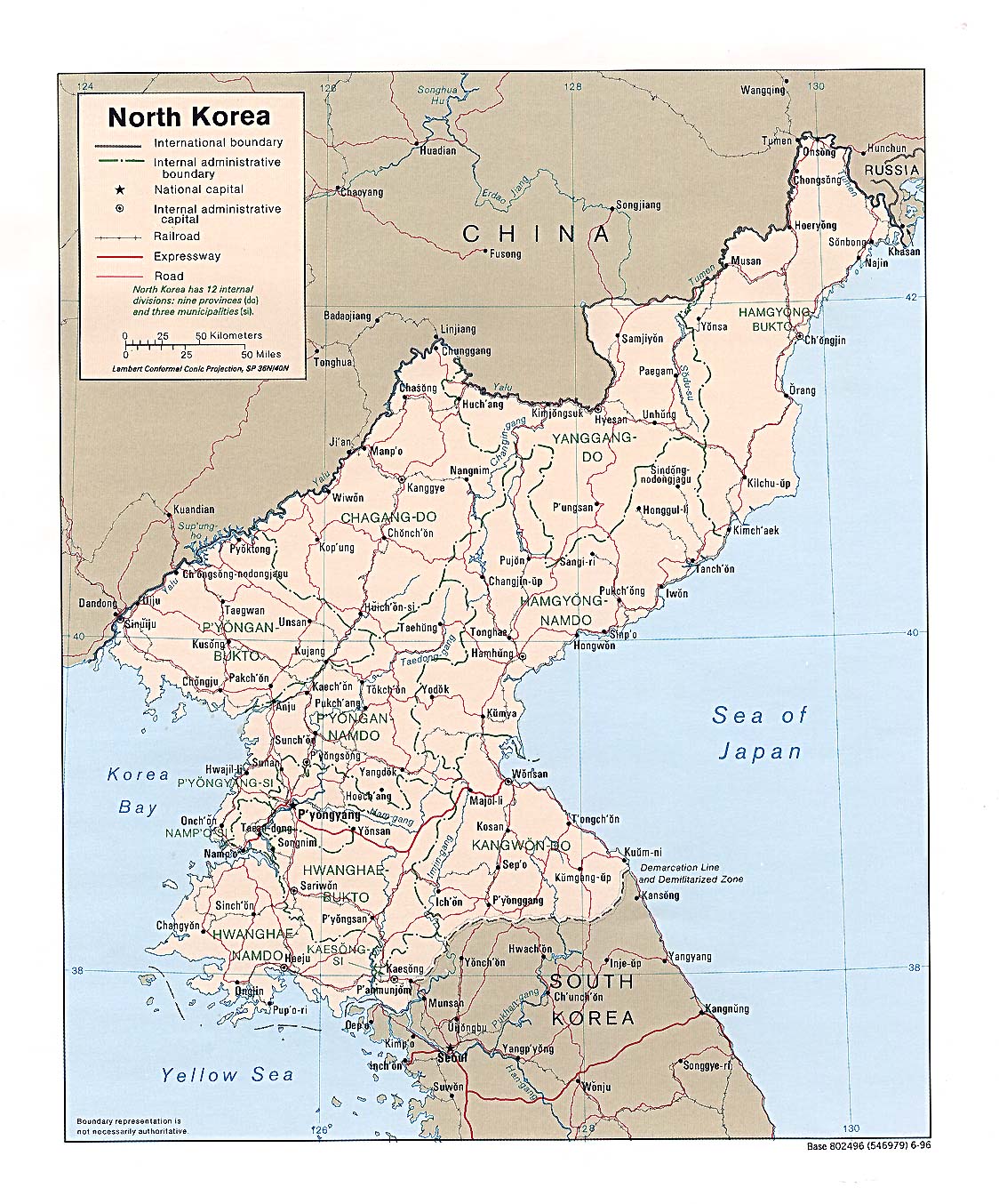
China has a huge border control effort against the DPRK. If they didn't, there would be no one left inside. South Korea might let them in--many of its citizens long for unification--but there is the De-Militarized Zone (DMZ). No DPRK citizen is likely to make it across. The U.S. is still patrolling its side of the DMZ with troops of the Republic of Korea (aka ROK or South Korea). It's my understanding this is justifiably considered a dangerous assignment. There is no truce in the DMZ.
In US memory, that conflict was over fifty years ago. But it is not over.

We Can't Always Get Who We Want
1. We can learn from this man, primarily known for his immorality and his laughably transparent extortion schemes, how important the international community views the institution of the state. Despite the over-excited accusations of some anti-war protesters (of which I am occasionally one, depending, but rarely over-excited) it remains a huge decision to enter another states' territory. Especially since DPRK does fulfill, at least in half-measure, the criteria of a state--
--A failing state. We try not to invade too many of those. (Afghanistan, for instance, but not Somalia.) The people who usually invade failing states are brigands and/or neighbor states. When neighbor states invade in this enlightened era, it is generally for peacekeeping purposes.
Furthermore, Kim Jong-Il came into power under a peaceful transfer from his father--not democracy, not transparent, but no civil war ensued. Therefore, we are still trying to reason with him, bribe him, contain him. The effort has been a drawn-out, careful, considered labor for some of our best diplomats--primarily those of the U.S., China, Russia, Japan, and South Korea--in what is called the "Six-Party Talks" or "Six-Nation Talks." This makes all states at the table sound equal: three hegemonic states, five powerful economies, and the DPRK. And all states are indeed equal in the international system. They get the same privileges of sovereignty.
2. We can also learn from this man, who always seems to have nuclear material, how incredibly easy it is to get plutonium. There are no indigenous plutonium deposits in the DPRK. Nor is there much technological basis for the development of these weapons. We do know that A.Q. Khan of Pakistan sold information and equipment to the DPRK, among others. If we know the Dear Leaders' other suppliers, we're not telling. Every time we close one door, somebody else climbs through the window, bearing dangerous gifts.
3. We can also learn from this leader that extortion payments are sometimes necessary to make. He's got the radioactive trump card, so that makes him someone to listen to. It does not augur well for nuclear non-proliferation.
The Wham Bam Option
The biggest reason we stall with Dear Leader is that three major powers find it necessary to avoid the expansion of any one of the others. We don't want China on the ROK border. China has enough border with Russia already. It doesn't want any with us. And so forth.
The second reason is that all five major economies are under some risk of nuclear damage--fallout, bombing, reactor meltdown. Flattery and promises help keep Kim Jong-Il from destroying those economies in a tantrum. Likewise, a setback or a partial dismantlement creates delay and confusion for development of fissile weapons. So we use anything that interferes--if not a sword, then a stick. If not a stick, then a twig, or a carrot, or a shipment of wheat.
The third reason to persevere is that this failing state is a huge mystery. We have no idea who will control it when the Dear Leader dies, or who will control its fissile material. A huge politico-military class will either solidify into another dictatorship or fight between themselves. This latter would be a huge heaping mess. It would create clandestine, amateur nuclear sales, not a good development for the fight against terrorism or international crime.
It's said that Dear Leader has pancreatic cancer. I am sure he has enough opium to get by. I find that a great pity. But in other ways, I wish him a long life. We do not sufficiently focus on this man and his state. We are not ready for him to depart his own barren rock and enter the great beyond.
References
1. The Center for Defense Information (2003) on the restart of the DPRK uranium program and its plutonium program.
2. BBC Timeline (2002-2007) that shows DPRK accession to, abdication of non-proliferation--and a record of agreements, aid given, and agreements reneged.
3. Wikipedia Timeline (1989--2009)--a longer timeline and different references.
4. The DPRK Space Program at FAS. The Federation of American Scientists is not a pretty site--but very functional. And it is a GREAT site for U.S. security matters.
5. The New Yorker magazine (e-subscription only). For gossip on Dear Leader's Wonderland, try 'Kimworld' by Ian Buruma. For a look at its persistent famine, try 'The Good Cook', about a woman trying to feed her family of 6. The New Yorker also has articles on some U.S. agency work, and (Bill) Clintonian ambassadorship in the DPRK.
Images; University of Texas Perry Castaneda Library for the map; East Asia Forum for the pageant. Both are also good sites to know.

Images; University of Texas Perry Castaneda Library for the map; East Asia Forum for the pageant. Both are also good sites to know.

Sunday, January 24, 2010
Oil Spill in Port Arthur
This is a bad news but good news story. The bad news is that the tug w/ 2 barges collided with the tanker. The good news is that the Coast Guard and the oil company got right on containment, it's in a low-turbulence area, and not in the immediate vicinity of any wetlands. The water movement matters because high turbulence increases the spread. It also makes globs of oil-mixed-with-salt-water foam, a kind of stinky soapy glop that's harder to suck up or get rid of.
Because crap happens, people learn to deal, and they know what to do. But I'm not Pollyanna. There's always a loss when a mistake like this is made. This matters extremely for the ecology of the Gulf of Mexico and the near environs of Houston.
One note: the area was evacuated because of sulfides in the oil. Everybody needs to know that this is going to be forever common. The oil we are drilling now is increasingly more sulphurous or 'sour' crude. The wells of sweet light crude are lucky finds among the newer wells, pumping off the top. As we return to old wells with new technology, to get more of what we couldn't reach before, the oil is not as sweet. Other top-producing wells world-wide are sour, too: it depends. It's the refining that takes the sulphur out, and increasingly sulphur disposal is becoming a problem in the oil industry.
So the presence of sulfides also suggests that the oil had not yet been refined. There are refineries in the Caribbean, in fact the political climate for building one there is much more friendly. But you can bet things are screwed up for refining with all the rescue traffic to Haiti. The effects of Haiti's earthquake aren't just in Haiti, but all over--including, this minute, probably Houston. We are all one.
Because crap happens, people learn to deal, and they know what to do. But I'm not Pollyanna. There's always a loss when a mistake like this is made. This matters extremely for the ecology of the Gulf of Mexico and the near environs of Houston.
One note: the area was evacuated because of sulfides in the oil. Everybody needs to know that this is going to be forever common. The oil we are drilling now is increasingly more sulphurous or 'sour' crude. The wells of sweet light crude are lucky finds among the newer wells, pumping off the top. As we return to old wells with new technology, to get more of what we couldn't reach before, the oil is not as sweet. Other top-producing wells world-wide are sour, too: it depends. It's the refining that takes the sulphur out, and increasingly sulphur disposal is becoming a problem in the oil industry.
So the presence of sulfides also suggests that the oil had not yet been refined. There are refineries in the Caribbean, in fact the political climate for building one there is much more friendly. But you can bet things are screwed up for refining with all the rescue traffic to Haiti. The effects of Haiti's earthquake aren't just in Haiti, but all over--including, this minute, probably Houston. We are all one.
Saturday, January 23, 2010
Haiti Update 4--Security Round-up--new video added
For the mostly-good-but-absolutely-true news, check the Big Picture blog entry for Haiti, ten days in. Forty-six photos show a range of human emotion on Haiti's people and their caregivers. Nearly every photo depicts a human being who has their humanity back, full force.
It's impossible to evaluate security measures completely without access to Command Centers somewhere. But this round-up of articles may give a sense of the challenges and victories, holding actions and improvements. This picture is of a security guard on Jan 19th or thereabouts, someone attempting to keep order. (Reuters/London Telegraph)

January 19, 2010
The Telegraph reports that Haitian police have conceded that they've lost control of security, particularly in the waterfront slum Cite' Soleil. Rescue workers have been attacked, which probably means that rescue work is suspended in that area.
CNN similarly reports that the Haiti police are ill-equipped., with looting everywhere. Also according to CNN on January 19, (substantive article) the UN Security Council would be asked to approve another 2,000 soldiers and 1500 police officers into Haiti. The word is "quickly" rather than an actual date. Logistics again play a factor, and also diplomatic wrangling about who's going when, but still a good move.
January 20, 2010
Apparently the appeal to vigilantism was answered with vigilante enforcement within several areas. Former gang leaders and others have been executed without trial. From the Guardian. Several vigilante groups have blockaded neighborhoods in an attempt to keep order.
January 21, 2010
The Washington Post reports seven police officers from Prince George's County, Maryland, will deploy to Haiti. All are of Haitian descent, who will know the language. Godspeed to them.
Orphanages have been attacked, and food stolen, at CNN.
January 22, 2010
The BBC headline "Haiti police appeal for help over escaped prisoners' makes it sound like the police are utterly overwhelmed, but further down in the article, BBC notes 'vast majority is calm' and 'sporadic violence in the historically troubled Cite' Soleil area.' So it sounds like definite progress. Here is a video, from Salemnews.com, that shows calm among the debris:
This video, however, displays the difficulties attendant with that 'sporadic violence':
**Canadian RCMP volunteers seek to replace their two officers fallen in Haiti. This is a wonderful article, because it includes part of Sgt. Mark Gallagher's assessment of Haitian crime and policing Before the Quake. From the Toronto Star: if you read nothing else, this article will be worth it.
This video shows great footage of the peacekeepers from China, and a great deal about how it looks from the inside of an armored vehicle--now preferred. Note: the introduction reads twice in this video before you get to the actual story.
January 23, 2010
Increased security is going to facilitate every other kind of security there is. For instance:
from the Wall Street Journal: Haitians regain access to cash. The banks are full of soldiers and private security, but you can now buy instead of steal or barter. A huge step forward, for this grim and terrible trouble. Many thanks to our security providers everywhere.

It's impossible to evaluate security measures completely without access to Command Centers somewhere. But this round-up of articles may give a sense of the challenges and victories, holding actions and improvements. This picture is of a security guard on Jan 19th or thereabouts, someone attempting to keep order. (Reuters/London Telegraph)

January 19, 2010
The Telegraph reports that Haitian police have conceded that they've lost control of security, particularly in the waterfront slum Cite' Soleil. Rescue workers have been attacked, which probably means that rescue work is suspended in that area.
Police officers, whose limited success against slum gang lords has been based on the support of armoured UN troops, have now effectively given up by appealing to local vigilantes to take the law into their own hands."If you don't kill the criminals, they will all come back," Haitian police officers announce over loudspeakers from heavily armed checkpoints in the slum area.Residents say that people have been killed and several women raped in a turf war between gangsters nicknamed "Belony" and "Bled" in the six days following the earthquake which destroyed the prison.
CNN similarly reports that the Haiti police are ill-equipped., with looting everywhere. Also according to CNN on January 19, (substantive article) the UN Security Council would be asked to approve another 2,000 soldiers and 1500 police officers into Haiti. The word is "quickly" rather than an actual date. Logistics again play a factor, and also diplomatic wrangling about who's going when, but still a good move.
January 20, 2010
Apparently the appeal to vigilantism was answered with vigilante enforcement within several areas. Former gang leaders and others have been executed without trial. From the Guardian. Several vigilante groups have blockaded neighborhoods in an attempt to keep order.
January 21, 2010
The Washington Post reports seven police officers from Prince George's County, Maryland, will deploy to Haiti. All are of Haitian descent, who will know the language. Godspeed to them.
Orphanages have been attacked, and food stolen, at CNN.
January 22, 2010
The BBC headline "Haiti police appeal for help over escaped prisoners' makes it sound like the police are utterly overwhelmed, but further down in the article, BBC notes 'vast majority is calm' and 'sporadic violence in the historically troubled Cite' Soleil area.' So it sounds like definite progress. Here is a video, from Salemnews.com, that shows calm among the debris:
This video, however, displays the difficulties attendant with that 'sporadic violence':
**Canadian RCMP volunteers seek to replace their two officers fallen in Haiti. This is a wonderful article, because it includes part of Sgt. Mark Gallagher's assessment of Haitian crime and policing Before the Quake. From the Toronto Star: if you read nothing else, this article will be worth it.
This video shows great footage of the peacekeepers from China, and a great deal about how it looks from the inside of an armored vehicle--now preferred. Note: the introduction reads twice in this video before you get to the actual story.
January 23, 2010
Increased security is going to facilitate every other kind of security there is. For instance:
from the Wall Street Journal: Haitians regain access to cash. The banks are full of soldiers and private security, but you can now buy instead of steal or barter. A huge step forward, for this grim and terrible trouble. Many thanks to our security providers everywhere.

From Big Picture Blog, linked above.
Wednesday, January 20, 2010
America Fries the French Potato
First, you have to read about the tantrum: US accused of 'occupying' Haiti. Mon Dieu!!!! A functionary from the country that gave us the Napoleon complex disses the nation that birthed film noir AND Jerry Lewis, not to mention the Marshall Plan.
--from AFP wire service---
(Agence-France-Presse) In a stunning coup de foudre, the vile Americans have announced their imperialist intention of ruling the Caribbean Ocean. The initial move was accomplished over a twenty-four hour �action period� which occurred after forces mobilized from Haiti in a 'deployment staging subterfuge'.
In Operation Rolled Cigar, the Americans completed their takeover of the island of Hispaniola. Simultaneously, U.S. Marines took over the British, French, and Dutch Antilles with a report of two total casualties. Jamaica surrendered in the face of one gunboat, the USS Golightly, which supported five landing craft. It is believed the lack of Jamaican resolve was clinched by the use of reggae and reggaeton soundtracks, which boomed at high amplitude from shipboard speakers.
�It�s just amazing,� Admiral Forthwith said, at a dawn press conference. �Those island-hopping tactics we learned on our way to the Phillippines are still totally relevant, over fifty years later. This shows why we never throw anything away in War Plans.� He added, �Music is one universal language; but firepower is what the U.S. Navy calls the universal amplifier.�
The U.S. Department of Defense has blacked out satellite pictures on Google Earth, but early indications are that a force is now converging on Cuba, with major supply chain being routed through Puerto Rico.
"It is not the first time that the land-sucking and imperialistic Americans have enforced their schizophrenic will on a carefree Caribbean," French think-tank director Remi Toulouse asserted. [Ed. note: Agence France Presse continues with various military actions in the Reagan years] "It is obvious to all of France and indeed, the entire European Community, that these previous forays were merely practice for an all-out display of crude American machismo."
UN Security Council attempts U.S. rebuke, but can't get quorum
The move stunned the UN Security Council, which broke out into a fistfight at about 2 a.m. this morning.
The American diplomat was rushed to the hospital as diplomats from France and the United Kingdom forcibly protested the loss of their Caribbean territories. Unsubstantiated reports say that delegates from various Latin American countries held the U.S diplomat immobile while the delegate from France tried to make his point.
"He hits like a baby," the Venezuelan diplomat noted. "He whined about hurting his hand, too."
The Russian delegate to the Security Council was also carried to Bellevue, reportedly after choking on his own laughter.
�America is doing only what we are attempting with Japan,� he explained, once released from the hospital. When pressed, he did admit it had been a shock to the Russian government as well. �But opportunity knocks. We feel same way about Russo-Japanese War,� he said. �Who knew American government had such long memory for insults?� He laughed again. �We know they are merely avenging the Cuban Missile Crisis.�
When asked if Russia expected any repercussions from its part in the Cuban Missile Crisis, he shrugged
�That was idiot Krushchev and USSR. We are new Russia, with many oil contracts. I think Castro must be shitting cocaine turds by now.�
Nobel Peace Prize??
At the White House press conference, Obama looked grave and determined. �All the hardship of the American people in the fight against drugs will be halved after this operation is completed,� he said, striking his fist on the podium. �We do not anticipate this operation to cost American taxpayers any additional funds, especially since we now have control of the Cayman Islands and the other financial paradises of the Caribbean. Already, American accountants have located lost funds and drug money that should pay for everything, including reconstruction. We may even pay off the deficit.�
On the streets of Paris, citizens deplored the American move, but did not seem unduly worried, as interest spikes over the pret-a-porter fashion shows that begin next week. �Merde, it is the crime committed to spread Disney World," said the one concerned person this reporter located. "We would rather have the heroin. Mon amis, have you any?"
--from AFP wire service---
Alors! U.S. invades Back Yard
(Agence-France-Presse) In a stunning coup de foudre, the vile Americans have announced their imperialist intention of ruling the Caribbean Ocean. The initial move was accomplished over a twenty-four hour �action period� which occurred after forces mobilized from Haiti in a 'deployment staging subterfuge'.
In Operation Rolled Cigar, the Americans completed their takeover of the island of Hispaniola. Simultaneously, U.S. Marines took over the British, French, and Dutch Antilles with a report of two total casualties. Jamaica surrendered in the face of one gunboat, the USS Golightly, which supported five landing craft. It is believed the lack of Jamaican resolve was clinched by the use of reggae and reggaeton soundtracks, which boomed at high amplitude from shipboard speakers.
�It�s just amazing,� Admiral Forthwith said, at a dawn press conference. �Those island-hopping tactics we learned on our way to the Phillippines are still totally relevant, over fifty years later. This shows why we never throw anything away in War Plans.� He added, �Music is one universal language; but firepower is what the U.S. Navy calls the universal amplifier.�
The U.S. Department of Defense has blacked out satellite pictures on Google Earth, but early indications are that a force is now converging on Cuba, with major supply chain being routed through Puerto Rico.
"It is not the first time that the land-sucking and imperialistic Americans have enforced their schizophrenic will on a carefree Caribbean," French think-tank director Remi Toulouse asserted. [Ed. note: Agence France Presse continues with various military actions in the Reagan years] "It is obvious to all of France and indeed, the entire European Community, that these previous forays were merely practice for an all-out display of crude American machismo."
UN Security Council attempts U.S. rebuke, but can't get quorum
The move stunned the UN Security Council, which broke out into a fistfight at about 2 a.m. this morning.
The American diplomat was rushed to the hospital as diplomats from France and the United Kingdom forcibly protested the loss of their Caribbean territories. Unsubstantiated reports say that delegates from various Latin American countries held the U.S diplomat immobile while the delegate from France tried to make his point.
"He hits like a baby," the Venezuelan diplomat noted. "He whined about hurting his hand, too."
The Russian delegate to the Security Council was also carried to Bellevue, reportedly after choking on his own laughter.
�America is doing only what we are attempting with Japan,� he explained, once released from the hospital. When pressed, he did admit it had been a shock to the Russian government as well. �But opportunity knocks. We feel same way about Russo-Japanese War,� he said. �Who knew American government had such long memory for insults?� He laughed again. �We know they are merely avenging the Cuban Missile Crisis.�
When asked if Russia expected any repercussions from its part in the Cuban Missile Crisis, he shrugged
�That was idiot Krushchev and USSR. We are new Russia, with many oil contracts. I think Castro must be shitting cocaine turds by now.�
Nobel Peace Prize??
At the White House press conference, Obama looked grave and determined. �All the hardship of the American people in the fight against drugs will be halved after this operation is completed,� he said, striking his fist on the podium. �We do not anticipate this operation to cost American taxpayers any additional funds, especially since we now have control of the Cayman Islands and the other financial paradises of the Caribbean. Already, American accountants have located lost funds and drug money that should pay for everything, including reconstruction. We may even pay off the deficit.�
On the streets of Paris, citizens deplored the American move, but did not seem unduly worried, as interest spikes over the pret-a-porter fashion shows that begin next week. �Merde, it is the crime committed to spread Disney World," said the one concerned person this reporter located. "We would rather have the heroin. Mon amis, have you any?"
---end of wire---
With apologies to Agence France Presse, which is a Very good news agency--and thanks to Beat & Release, for bringing the article to my attention!
With apologies to Agence France Presse, which is a Very good news agency--and thanks to Beat & Release, for bringing the article to my attention!
Haiti, Update 3--The Public Health Matters
The UN continues to be Fact Central for charities and governments all over the world, including our own. They are the leading proponent and most coordinated system for ensuring world public health.
Epidemic Worries
According to the paper I read, epidemic disease has always been a concern of aid organizations during quake disasters. Historically, though, post-quake epidemic has not occured on the feared scale. That can be because rescue always kept it in mind and so averted a second wave of disaster. But Haiti has significant health deficits, and of course their infrstructure for public health is gone.
Good Figures to Work With
The reported immunization rate in Haiti against diptheria, tetanus, measles, and other childhood diseases is all over the map, generally between 40-60%. The WHO goal was to deliver immunizations at a rate close to 80%. You can say what you like about immunization in this developed country, but diptheria, tetanus, and measles are potentially fatal diseases. The immunization level indicates that about 50% of population is threatened.
Population: 9,035,536. (all ages, entire country). Figures are 2009 unless otherwise specified.
Bad Sanitation/Waterborne and Foodborne Disease
Port-au-Prince, before the earthquake, had 70% of its population able to access clean water; for the country in full, about 58% had access to clean water. Therefore, the system never reached everybody. Previous to the eathquake, the country was already considered a high-risk area for bacterial and protozoal diarrhea, hepatitis A and E, and typhoid fever. Another water-borne disease noted by the CIA Factbook as a high risk includes leptospirosis.

Water facilities were one of the first apparatus brought by many rescue teams, and bottled water continues to be delivered by the Joint Task Force and others. Yet this capacity will need to be increased--and worse--maintained. Some of the purifiers came as portable factories and were initial or stop-gap measures. Some of these facilities (e.g., Oxfam's) have run out of fuel and are therefore shut down temporarily. Water will continue to be part of the logistic nightmare. New systems of distribution (not using damaged or vandalized water mains) will undoubtedly be a priority.
Malaria, HIV, Tuberculosis
Haiti is a tropical state with endemic malaria (164,590 cases). The ruins create more possible avenues for mosquito-borne disease. January is traditionally a dry month. The rainy season begins about May, right along with hurricane season, so this is a deadline of a sort for bulldozing, demolition. amd mosquito control, as well as housing.
Haiti also has a high percentage of HIV in the adult population: 2.2%, or about 120,000 adults. (100,000 to 140,00; 120,000 is considered best estimate.)
Tuberculosis: a reported 35, 099 cases. 29,333 of those cases were first reported in 2007. Now you see what I mean about recent improvements in Haiti's public health reporting.
Note: The Red Cross notes on its site that dead people, while distressing, are not significant carriers of disease. The danger of epidemic comes from living people. Those who work with the dead need to be able to clean up in order to remove any bacteria from fecal matter, but are not likely to otherwise become ill. So we are back to water again.
References/Further Reading: UNICEF, Haiti Country Statistics; World Health Organization research portal; Index Mundi with a huge list of possible diseases to catch.
Picture from Big Picture blog at Boston.com-- a vandalized water pipe in Cite Soleil slum of Port-au-Prince.
Epidemic Worries
According to the paper I read, epidemic disease has always been a concern of aid organizations during quake disasters. Historically, though, post-quake epidemic has not occured on the feared scale. That can be because rescue always kept it in mind and so averted a second wave of disaster. But Haiti has significant health deficits, and of course their infrstructure for public health is gone.
Good Figures to Work With
Haiti has participated in the UNICEF and World Health Organization data collection, so we do have some information on the risks that will complicate health care delivery there. It's important to note ALL countries self-report health stats to the UN. That means each number relies on the skill and the honesty of the reporting country. Looking at these figures, I would say that Preval's tenure as president/ the MINUSTAH presence has shown a marked increase in capability and honesty in reporting figures. The figures will still probably be somewhat low, since the population was still underserved.
The reported immunization rate in Haiti against diptheria, tetanus, measles, and other childhood diseases is all over the map, generally between 40-60%. The WHO goal was to deliver immunizations at a rate close to 80%. You can say what you like about immunization in this developed country, but diptheria, tetanus, and measles are potentially fatal diseases. The immunization level indicates that about 50% of population is threatened.
Population: 9,035,536. (all ages, entire country). Figures are 2009 unless otherwise specified.
Bad Sanitation/Waterborne and Foodborne Disease
Port-au-Prince, before the earthquake, had 70% of its population able to access clean water; for the country in full, about 58% had access to clean water. Therefore, the system never reached everybody. Previous to the eathquake, the country was already considered a high-risk area for bacterial and protozoal diarrhea, hepatitis A and E, and typhoid fever. Another water-borne disease noted by the CIA Factbook as a high risk includes leptospirosis.

Injuries and Injury-based Infections.
Tetanus: There's a 72-hour window from exposure to tetanus-exposed soil and the ability to immunize against tetanus. The disease itself is extremely lethal, causing muscle rigidity and excruciating pain. According to some reports, there are long lines where Haitians have been able to seek tetanus shots. So the word is getting out.
Estimates of the number of injured are still incomplete. Latest reports estimate 250,000 injured. That would be a quarter of a million tetanus injections--
Malaria, HIV, Tuberculosis
Haiti is a tropical state with endemic malaria (164,590 cases). The ruins create more possible avenues for mosquito-borne disease. January is traditionally a dry month. The rainy season begins about May, right along with hurricane season, so this is a deadline of a sort for bulldozing, demolition. amd mosquito control, as well as housing.
Haiti also has a high percentage of HIV in the adult population: 2.2%, or about 120,000 adults. (100,000 to 140,00; 120,000 is considered best estimate.)
Tuberculosis: a reported 35, 099 cases. 29,333 of those cases were first reported in 2007. Now you see what I mean about recent improvements in Haiti's public health reporting.
Note: The Red Cross notes on its site that dead people, while distressing, are not significant carriers of disease. The danger of epidemic comes from living people. Those who work with the dead need to be able to clean up in order to remove any bacteria from fecal matter, but are not likely to otherwise become ill. So we are back to water again.
References/Further Reading: UNICEF, Haiti Country Statistics; World Health Organization research portal; Index Mundi with a huge list of possible diseases to catch.
Picture from Big Picture blog at Boston.com-- a vandalized water pipe in Cite Soleil slum of Port-au-Prince.
Subscribe to:
Posts (Atom)


